Buy primae.eu ?
We are moving the project
primae.eu .
Are you interested in purchasing the domain
primae.eu ?
domain@kv-gmbh.de · 0541-91531010
Buy primae.eu ?
What is an isometry with non-orthogonal vertices?
An isometry with non-orthogonal vertices is a transformation that preserves distances and angles between points, but the vertices are not at right angles to each other. This means that the shape is still congruent to its original form, but the angles between the edges are not necessarily 90 degrees. Isometries with non-orthogonal vertices can include translations, rotations, reflections, and glide reflections. These transformations are important in geometry and can help us understand the properties of shapes in different orientations. **
What is an isometry with non-orthogonal corners?
An isometry with non-orthogonal corners is a transformation that preserves distances and angles, but the corners of the shape are not at right angles to each other. This means that the shape is still congruent to its original form after the transformation, but the angles at the corners are not 90 degrees. Isometries with non-orthogonal corners can include rotations, reflections, translations, and glide reflections. These transformations are important in geometry and can be used to study the properties of shapes and figures. **

Similar search terms for Non-orthogonal
Top-Angebote
Products related to Non-orthogonal:
-
Tools, Home & Hobby Adjustable Aerobic Step Platform Workout Stepper With Non Slip Fitness Deck Adjustable Aerobic Step Platform Workout Stepper With Non Slip Fitness DeckTransform your home workouts with a versatile aerobic step platform designed to improve cardio, strength, and balance training. This durable stepper provides a stable surface for beginners, fitness enthusiasts, and athletes looking to enhance their...99,97 $*Shipping: 0,00 $Secure redirect to the provider
-
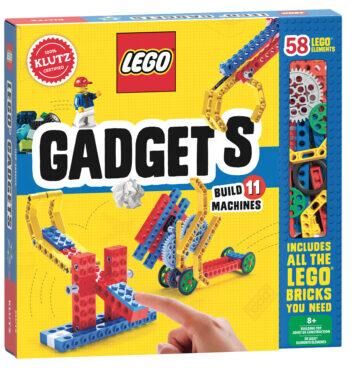
Klutz: LEGO GadgetsThis activity kit will have you building 11 machines including a gravity powered car and a wacky boxing robot. The fun doesn't stop once you've completed all of the projects in the book - open-ended prompts will inspire you to continue experimenting...24,99 $*Shipping: 0,00 $Secure redirect to the provider
-
Inspire Daily Merch Durable Reusable Pet Hair Removal Dryer Balls Non Electric Lint Catcher For Laundry Washing Accessories Durable Reusable Pet Hair Removal Dryer Balls Non Electric Lint Catcher For Laundry Washing AccessoriesEfficient Pet Hair Removal for Laundry Say goodbye to pet hair stuck in your laundry! The 6pcs Reusable Pet Hair Removal Laundry Balls are designed to effortlessly capture and remove pet hair from your clothes during laundry cycles. Whether you're...29,97 $*Shipping: 0,00 $Secure redirect to the provider
-
Judge Essentials 28cm Non Stick Frying PanThe Judge Essentials 28cm Non Stick Frying Pan offers durable stainless steel construction with a non-stick coating for easy cooking and cleaning. This versatile frying pan is perfect for cooking on various hob types, including induction, and is oven safe up to 180°C, allowing you to prepare a wide range of dishes with ease. The heavy-duty base ensures superior heat retention for consistent cooking results, while the easy grip handle provides comfortable handling with low heat transmission.. Dishwasher safe for easy cleaning. Covered by a manufacturer's 10-year guarantee and a 2-year non-stick warranty.19,95 £*Shipping: 3,50 £Secure redirect to the provider



-
What is an orthogonal vector?
An orthogonal vector is a vector that is perpendicular to another vector. In other words, two vectors are orthogonal if their dot product is zero. Geometrically, this means that the two vectors form a 90-degree angle with each other. Orthogonal vectors are important in many areas of mathematics and physics, including linear algebra and vector calculus. **
-
What does the term orthogonal mean?
The term orthogonal refers to two things being perpendicular or at right angles to each other. In mathematics, it often refers to vectors or matrices that are perpendicular to each other. In a broader sense, it can also refer to any two things that are independent or unrelated to each other. **
-
When are planes and lines orthogonal?
Planes and lines are orthogonal when the line is perpendicular to the plane. This means that the line forms a 90-degree angle with the plane, creating a right angle. In other words, the direction of the line is perpendicular to the direction of the plane. This relationship is important in geometry and engineering, as it affects the intersection and orientation of different geometric elements. **
-
Are linearly independent vectors always orthogonal?
No, linearly independent vectors are not always orthogonal. Linear independence means that no vector in the set can be written as a linear combination of the others, while orthogonality means that the vectors are perpendicular to each other. It is possible for linearly independent vectors to be orthogonal, but it is not a guarantee. For example, in three-dimensional space, the vectors (1, 0, 0), (0, 1, 0), and (0, 0, 1) are linearly independent and orthogonal, but the vectors (1, 1, 0) and (0, 1, 1) are linearly independent but not orthogonal. **
What is a proof of two orthogonal?
Two vectors are considered orthogonal if their dot product is equal to zero. This means that the angle between the two vectors is 90 degrees, forming a right angle. Mathematically, if vectors u and v are orthogonal, then u · v = 0. This property can be used to prove that two vectors are orthogonal by calculating their dot product and showing that it equals zero. **
How do you determine the orthogonal complement?
To determine the orthogonal complement of a subspace, you first need to find a basis for the subspace. Then, you can use the Gram-Schmidt process to find an orthogonal basis for the subspace. Finally, the orthogonal complement is the set of all vectors in the vector space that are orthogonal to every vector in the basis of the subspace. **
Top-Angebote
Products related to Non-orthogonal:
-
Tools, Home & Hobby Adjustable Aerobic Step Platform Workout Stepper With Non Slip Fitness Deck Adjustable Aerobic Step Platform Workout Stepper With Non Slip Fitness DeckTransform your home workouts with a versatile aerobic step platform designed to improve cardio, strength, and balance training. This durable stepper provides a stable surface for beginners, fitness enthusiasts, and athletes looking to enhance their...99,97 $*Shipping: 0,00 $Secure redirect to the provider
-
Klutz: LEGO GadgetsThis activity kit will have you building 11 machines including a gravity powered car and a wacky boxing robot. The fun doesn't stop once you've completed all of the projects in the book - open-ended prompts will inspire you to continue experimenting...24,99 $*Shipping: 0,00 $Secure redirect to the provider
-
What is an isometry with non-orthogonal vertices?
An isometry with non-orthogonal vertices is a transformation that preserves distances and angles between points, but the vertices are not at right angles to each other. This means that the shape is still congruent to its original form, but the angles between the edges are not necessarily 90 degrees. Isometries with non-orthogonal vertices can include translations, rotations, reflections, and glide reflections. These transformations are important in geometry and can help us understand the properties of shapes in different orientations. **
-
What is an isometry with non-orthogonal corners?
An isometry with non-orthogonal corners is a transformation that preserves distances and angles, but the corners of the shape are not at right angles to each other. This means that the shape is still congruent to its original form after the transformation, but the angles at the corners are not 90 degrees. Isometries with non-orthogonal corners can include rotations, reflections, translations, and glide reflections. These transformations are important in geometry and can be used to study the properties of shapes and figures. **
-
What is an orthogonal vector?
An orthogonal vector is a vector that is perpendicular to another vector. In other words, two vectors are orthogonal if their dot product is zero. Geometrically, this means that the two vectors form a 90-degree angle with each other. Orthogonal vectors are important in many areas of mathematics and physics, including linear algebra and vector calculus. **
-
What does the term orthogonal mean?
The term orthogonal refers to two things being perpendicular or at right angles to each other. In mathematics, it often refers to vectors or matrices that are perpendicular to each other. In a broader sense, it can also refer to any two things that are independent or unrelated to each other. **
Similar search terms for Non-orthogonal
-
Inspire Daily Merch Durable Reusable Pet Hair Removal Dryer Balls Non Electric Lint Catcher For Laundry Washing Accessories Durable Reusable Pet Hair Removal Dryer Balls Non Electric Lint Catcher For Laundry Washing AccessoriesEfficient Pet Hair Removal for Laundry Say goodbye to pet hair stuck in your laundry! The 6pcs Reusable Pet Hair Removal Laundry Balls are designed to effortlessly capture and remove pet hair from your clothes during laundry cycles. Whether you're...29,97 $*Shipping: 0,00 $Secure redirect to the provider
-
Judge Essentials 28cm Non Stick Frying PanThe Judge Essentials 28cm Non Stick Frying Pan offers durable stainless steel construction with a non-stick coating for easy cooking and cleaning. This versatile frying pan is perfect for cooking on various hob types, including induction, and is oven safe up to 180°C, allowing you to prepare a wide range of dishes with ease. The heavy-duty base ensures superior heat retention for consistent cooking results, while the easy grip handle provides comfortable handling with low heat transmission.. Dishwasher safe for easy cleaning. Covered by a manufacturer's 10-year guarantee and a 2-year non-stick warranty.19,95 £*Shipping: 3,50 £Secure redirect to the provider
-
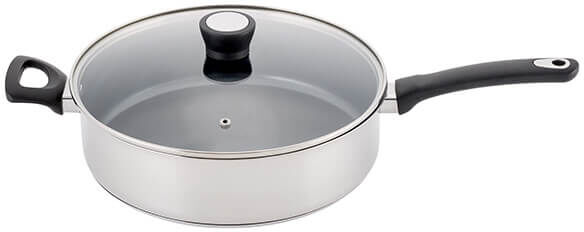
Judge Essentials 28cm Non Stick Saute PanThe Judge Essentials 28cm Non Stick Saute Pan offers versatile cooking on all hob types, including induction. Enjoy consistent results and easy maintenance with its durable stainless steel construction and non-stick coating. This saute pan features a heavy-duty base for superior heat retention, ensuring your meals are cooked evenly every time. The easy grip handles provide convenience and safety, while the vented glass lid allows you to monitor your cooking without lifting it. Crafted from stainless steel, this pan is designed for durability and lasting shine with minimal effort. It is oven safe up to 180°C and dishwasher safe, making clean-up a breeze. Dishwasher safe for easy cleaning. Supplied with a manufacturer's 10-year guarantee and a 2-year non-stick warranty.24,95 £*Shipping: 3,50 £Secure redirect to the provider
-
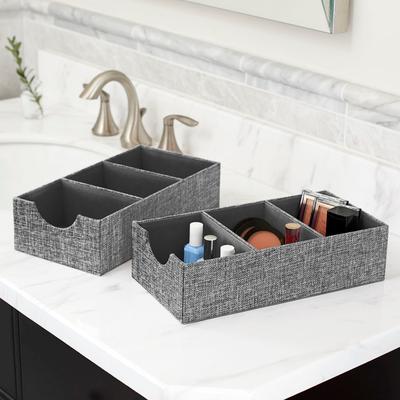
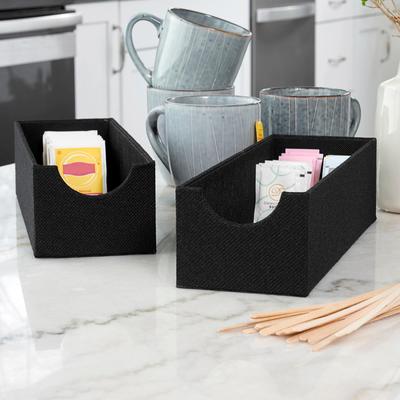
Household Essentials 2-Pack of Drawer OrganizersThe Drawer Organizer Tray (2-Piece Set) is a sleek and functional way to keep small items organized in tight spaces. Featuring a sturdy hard‑sided frame wrapped in soft polyester fabric, this tray combines durability with modern style.28,99 $*Shipping: 0,00 $Secure redirect to the provider
-
When are planes and lines orthogonal?
Planes and lines are orthogonal when the line is perpendicular to the plane. This means that the line forms a 90-degree angle with the plane, creating a right angle. In other words, the direction of the line is perpendicular to the direction of the plane. This relationship is important in geometry and engineering, as it affects the intersection and orientation of different geometric elements. **
-
Are linearly independent vectors always orthogonal?
No, linearly independent vectors are not always orthogonal. Linear independence means that no vector in the set can be written as a linear combination of the others, while orthogonality means that the vectors are perpendicular to each other. It is possible for linearly independent vectors to be orthogonal, but it is not a guarantee. For example, in three-dimensional space, the vectors (1, 0, 0), (0, 1, 0), and (0, 0, 1) are linearly independent and orthogonal, but the vectors (1, 1, 0) and (0, 1, 1) are linearly independent but not orthogonal. **
-
What is a proof of two orthogonal?
Two vectors are considered orthogonal if their dot product is equal to zero. This means that the angle between the two vectors is 90 degrees, forming a right angle. Mathematically, if vectors u and v are orthogonal, then u · v = 0. This property can be used to prove that two vectors are orthogonal by calculating their dot product and showing that it equals zero. **
-
How do you determine the orthogonal complement?
To determine the orthogonal complement of a subspace, you first need to find a basis for the subspace. Then, you can use the Gram-Schmidt process to find an orthogonal basis for the subspace. Finally, the orthogonal complement is the set of all vectors in the vector space that are orthogonal to every vector in the basis of the subspace. **
* All prices are inclusive of VAT and, if applicable, plus shipping costs. The offer information is based on the details provided by the respective shop and is updated through automated processes. Real-time updates do not occur, so deviations can occur in individual cases. ** Note: Parts of this content were created by AI.